
How to Search Broward County Court Records
The main public portal is the Broward Clerk Case Search. It covers civil, criminal, family, probate, traffic, and misdemeanor dockets in one place. The Clerk runs the system. The public site is free. Florida access standards still control which document images can be opened by which user.
The Clerk's case search lets a user pick one of four modes: Party Name, Business Name, Case Number, or Citation Number. Case number search is the most precise, but party name search is the most common. A user should plan the search before typing because the system caps results at the first 200 hits and short names trigger exact-match behavior. The Broward Clerk also runs an Advanced Search service for bulk-data customers under Florida's commercial-purchaser access level.
Visit the Broward Clerk public case search screen for the live search form.
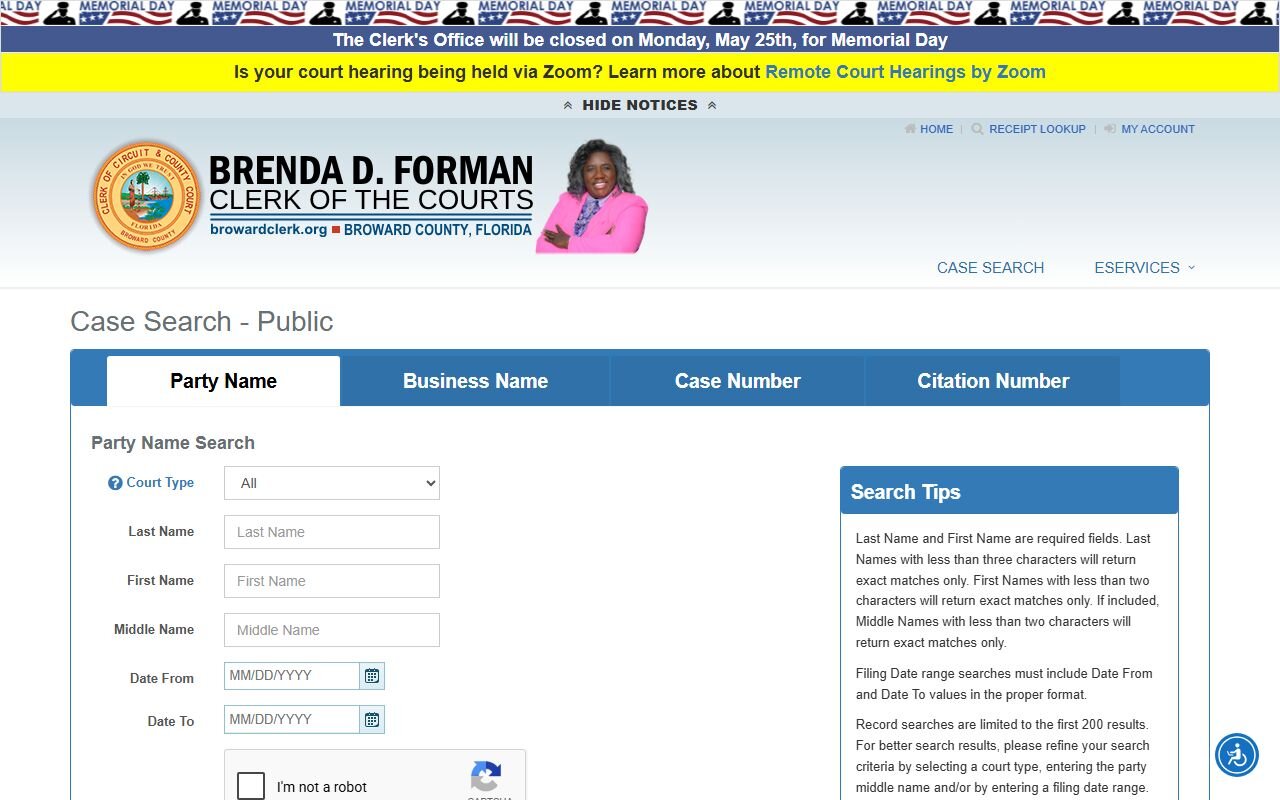
The image shows the four search tabs and the field layout used for every Broward County Court records search request.
- Open the Broward Clerk portal at browardclerk.org/Web2 in a current browser.
- Choose Party Name, Business Name, Case Number, or Citation Number.
- Type the last name and first name. Add a middle name to cut down on hits.
- Narrow with court type, civil case type, or a filing date range. Use both Date From and Date To.
- Click Search. Review the list of cases, then click into the case detail.
- Read the progress docket to find hearings, orders, and the disposition.
- Buy an electronic certified court document if the file is viewable and you need a court-ready copy.
- If a document is not online, use the Court Records Request Form for older or sealed files.
Broward County Court Records Search Fields
The Clerk's case search uses a small set of fields, but each field has its own rules. Short last names return only exact matches. Citation numbers must drop all dashes and spaces. Case number search needs the prefix, the two-digit year, and the sequence with no separators. The table below maps each field to its role.
| Field | Type | Required | Notes |
|---|---|---|---|
| Last Name | Text | Yes for party search | Last names under 3 characters return exact matches only. |
| First Name | Text | Yes for party search | First names under 2 characters return exact matches only. |
| Middle Name | Text | No | Short middle names return exact matches only. |
| Court Type | Dropdown | No | Civil, family, probate, felony, traffic, misdemeanor, and other types. |
| Date From / Date To | Date | Both required for date range | MM/DD/YYYY format. |
| Business Name | Text | Yes for business search | Searches business or organization parties. |
| Case Number | Text | Yes for case search | No spaces or dashes. Prefix plus year plus sequence. |
| Citation Number | Text | Yes for citation search | Traffic only. Boating citations must be searched by party. |
Note: results are capped at the first 200 hits, so use middle name, court type, or a date range when a name is common in Broward.
The Broward County Judicial System
Florida runs a two-tier trial court system. The Circuit Court is the court of general jurisdiction. The County Court is the limited-jurisdiction trial court. Broward County is the Seventeenth Judicial Circuit. Appeals from Broward run to the Fourth District Court of Appeal. The Florida Supreme Court sits above the appellate level. Visit the Florida court structure page for the statewide layout.
The Seventeenth Judicial Circuit's chief judge welcome page states that Broward serves nearly 2 million residents and runs four courthouse locations staffed with 90 judges and 11 magistrates or hearing officers. The current Chief Judge listed on the official site is Carol-Lisa Phillips.
The local judicial directory lists the divisions and the judges. The image below shows that public directory page.
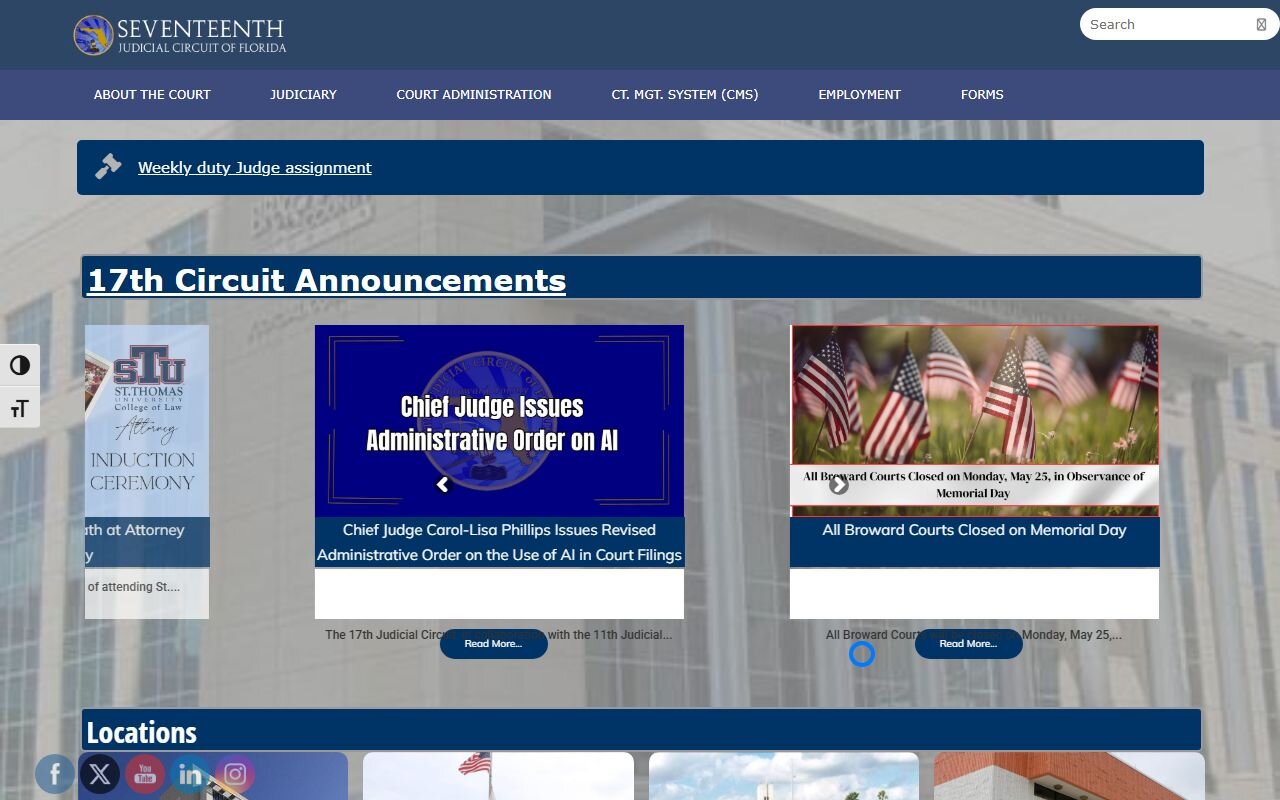
The Seventeenth Circuit page is the entry point for court news, division contacts, and judicial assignments that shape Broward County Court records.
Case flow: County Court › Circuit Court › Fourth District Court of Appeal › Florida Supreme Court
| Court | Role | Case Types |
|---|---|---|
| Broward County Court | Lower trial court | Misdemeanors, traffic, small claims, evictions, county civil up to $50,000. |
| Broward Circuit Court | Trial court of general jurisdiction | Felonies, family, probate, juvenile, civil above $50,000, injunctions. |
| Fourth District Court of Appeal | Intermediate appeals | Appeals from the 15th, 17th, and 19th circuits. |
| Florida Supreme Court | State high court | Discretionary review, capital cases, statewide rule-making. |
Broward County Courthouses
Broward keeps four main courthouses. The central complex sits in downtown Fort Lauderdale and groups several buildings around 201 SE 6th Street. The Midrise Building at 540 SE 3rd Avenue holds the Child Support Depository, marriage licenses, and the ceremony room. North Regional, South Regional, and West Regional courthouses handle traffic and other regional services. The Clerk's hours and locations page shows the full address list.
The image below comes from the Clerk's official courthouse list.
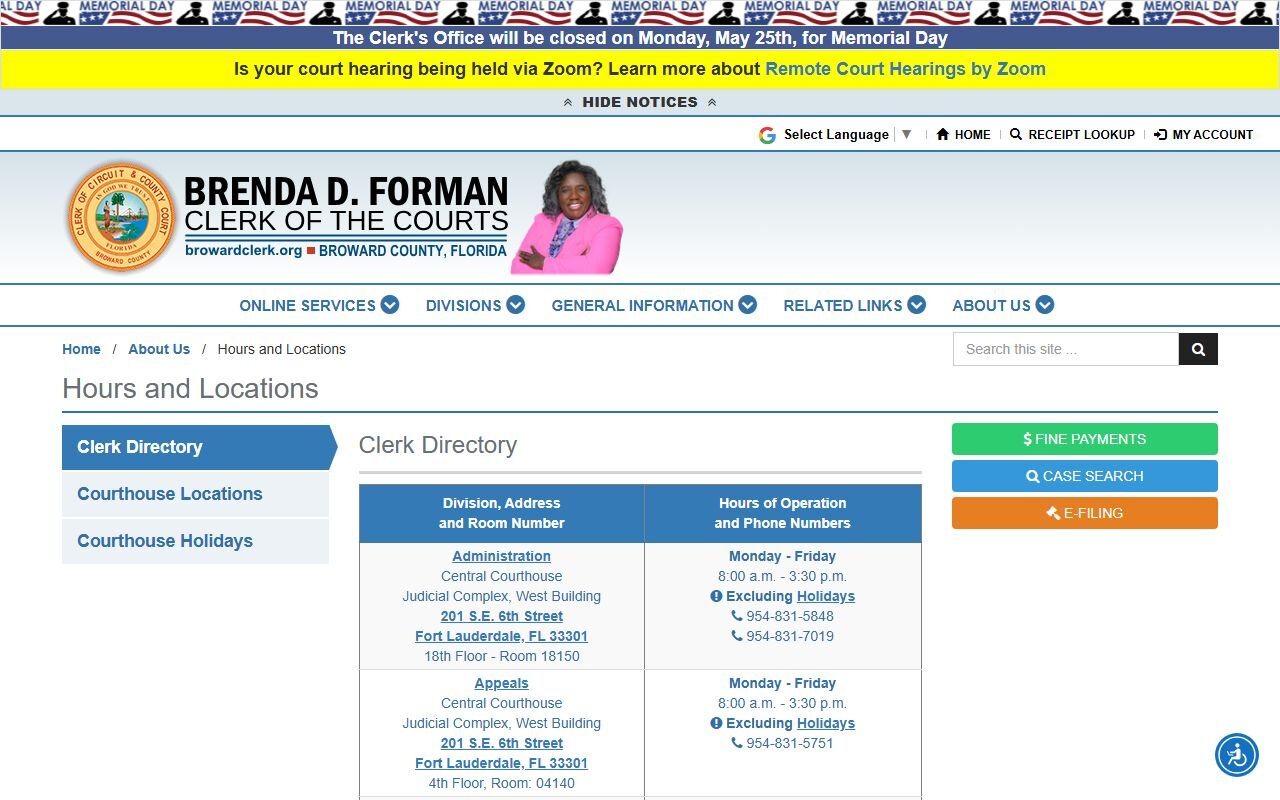
Use that page to confirm building, room, and counter hours before a visit because each Broward County Court division sits in a different part of the complex.
Central Courthouse (Judicial Complex)
201 SE 6th Street
Fort Lauderdale, FL 33301
954-831-6565
North Regional Courthouse
1600 West Hillsboro Boulevard
Deerfield Beach, FL 33442
954-831-6565
South Regional Courthouse
3550 Hollywood Boulevard
Hollywood, FL 33021
954-831-6565
West Regional Courthouse
100 North Pine Island Road
Plantation, FL 33324
954-831-6565
Types of Court Records Available in Broward County
The Clerk holds court records that fall into a small set of buckets. Most fall under Broward County court records. Each bucket has its own access rule. Some are open for public viewing. Others need an Attorney of Record or Registered User account before any document image can be opened.
Below is the working list of record types the Broward Clerk keeps.
- Criminal records - felony cases live in Circuit Criminal; misdemeanors live in County Court. See Broward County criminal records.
- Civil records - civil filings above $50,000 sit in Circuit Civil; smaller suits sit in County Civil.
- Family records - divorce, paternity, child support, and custody filings in the Unified Family division.
- Probate records - estates, wills, and guardianship in the Probate Division.
- Traffic records - civil traffic and criminal traffic in Broward County traffic court records.
- Marriage records - licenses issued by the Clerk's Marriage Division.
- Warrants and capias - issued by the court and posted to the case docket. See Broward warrant records.
- Jail and arrest - the Sheriff posts arrests at the BSO portal. See Broward inmate records.
What Broward County Court Records Show
Each Broward case file holds a set of fields that look the same across divisions. The fields below are the ones a user sees on a public case detail page or in the case progress docket. Sealed information stays hidden. Confidential fields, such as a Social Security number, are redacted under Florida Rule 2.420 and Rule 2.425.
| Field | What It Shows |
|---|---|
| Case Number | Prefix plus year plus sequence. Example: CACE15085978 for Civil Action Central; PRC110069874 for Probate. |
| Filing Date | The date the case opened in the Clerk's system. |
| Parties | Plaintiff and defendant, petitioner and respondent, or State of Florida and defendant. |
| Court Type | Circuit Civil, County Civil, Family, Probate, Domestic Violence, Felony, Misdemeanor, or Traffic. |
| Progress Docket | Date-stamped list of filings, hearings, and orders. |
| Disposition | Pending, dismissed, disposed, adjudicated, withhold adjudication, sealed, or expunged. |
| Hearings | Date, time, courtroom, judge, and hearing type when set. |
| Financials | Fines, court costs, restitution, bond, and payment status in criminal and traffic files. |
Public Access Laws for Broward County Court Records
Florida builds its open records system on three layers. Article I, section 24 of the Florida Constitution sets the right of access. Chapter 119 of the Florida Statutes governs agency records. Florida Rule of General Practice and Judicial Administration 2.420 governs judicial branch records, which the Clerk holds as custodian. The right is broad, but each layer carries exemptions. The Clerk applies the Florida Supreme Court's electronic access standards to decide what can be viewed by an anonymous user and what needs registered access.
The Broward Sheriff posts a separate public records request portal that runs under the same Chapter 119 framework. See the BSO public records request page for the agency-records side of the system.
Key Statutes:
Florida Statutes § 119.07 - sets the right to inspect and copy public records at reasonable times and requires custodians to redact exempt parts and produce the rest.
Florida Statutes Chapter 119 - the full Public Records Act, including general exemptions and enforcement.
Florida Rule 2.420 - judicial branch records access rule that controls electronic court documents at the Clerk.
Florida Statutes § 943.0585 - court-ordered expunction of criminal history records.
Florida Statutes § 943.059 - court-ordered sealing of criminal history records.
Note: a court file can show on the docket while the document image stays off-limits, because Rule 2.420 and Chapter 119 control the document layer.
Records That Are Restricted or Confidential
Some Broward case files carry tight access rules. The Clerk's records request page is clear that Domestic Violence, Family, Guardianship, Mental Health, and Probate electronic court records require an Attorney of Record or Registered User account before any document image can be opened. Juvenile and adoption records are even tighter. Juvenile records are only sold by the Juvenile division. Adoption files are not searched at the public counter.
The image below shows the Clerk's official records request page.
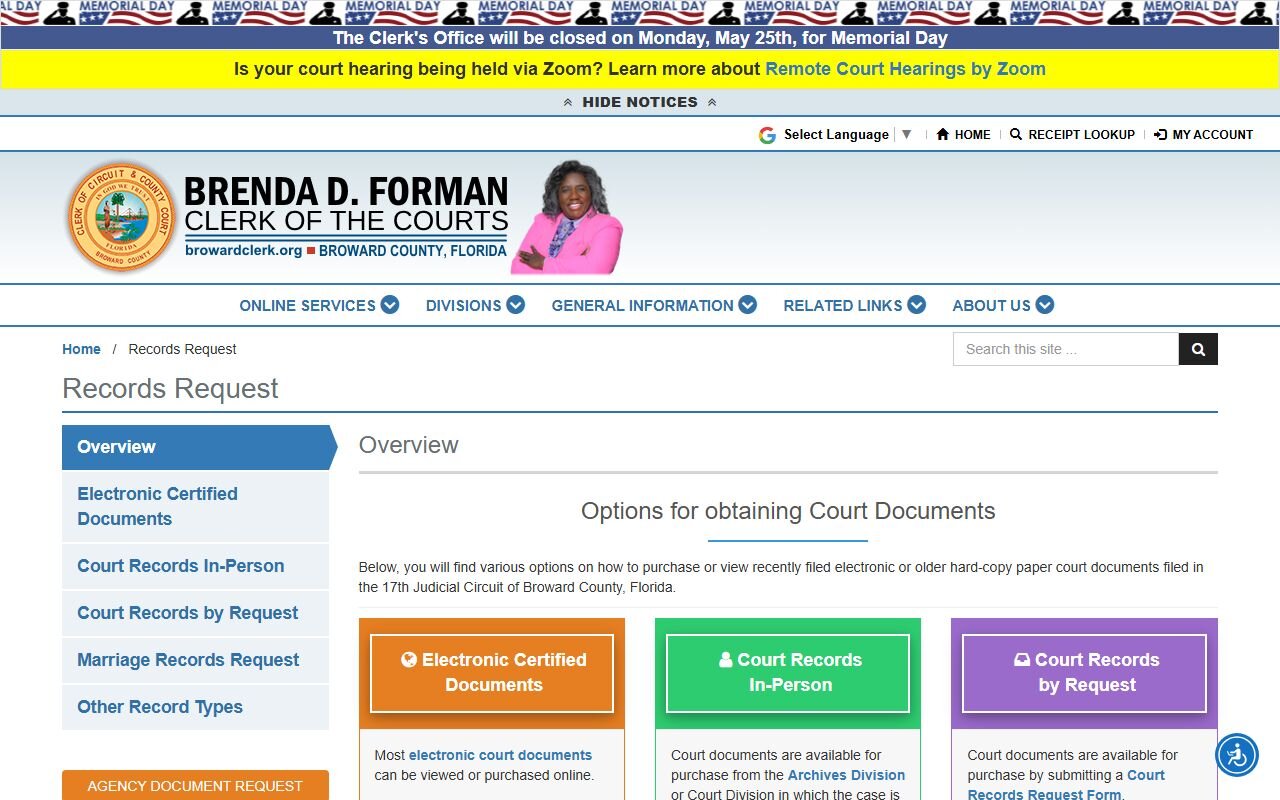
A user who hits a "documents not available" screen should look there before paying for a third-party report, because the request form is the official path for restricted Broward County Court records.
Sealed and expunged criminal cases follow a different rule. Once a court order seals or expunges a record under section 943.0585 or section 943.059, the public no longer sees the file. State agencies keep limited access. The Clerk and the State Attorney both screen for cleared records before public copies leave the building.
Specialty Courts in Broward County
The Seventeenth Judicial Circuit runs several problem-solving and specialized dockets. Drug and treatment court is the most common entry point for defendants whose conduct ties to substance abuse. Mental health court coordinates with the BSO North Broward Bureau, which the Sheriff identifies as a special-needs detention facility. The Department of Detention's 2026 message describes a RISE program that delivers individualized mental health services inside a designated jail unit and shortens court delays linked to waiting for state hospital beds.
Domestic violence cases run in the West Building under the Domestic Violence division. The State Attorney runs a Domestic Violence Unit, a Victim Advocate Unit, and other support services. Juvenile diversion is run by BSO's Department of Community Programs and the State Attorney's Office. Veterans-related coordination is listed among BSO's jail programs, but court placement depends on charge, service history, and prosecutorial approval. Each Broward specialty court keeps its own docket inside the main Clerk system.
Broward County Sheriff and Jail
The Broward Sheriff's Office runs the jail system, the Arrest Search portal, and the public records unit for law enforcement files. The BSO Department of Detention page states that the agency runs the 13th largest local jail system in the United States and that about 44,117 inmates are booked each year. The 2026 detention message lists about 40,000 individuals processed each year through Central Intake.
The image below comes from the BSO official home page.
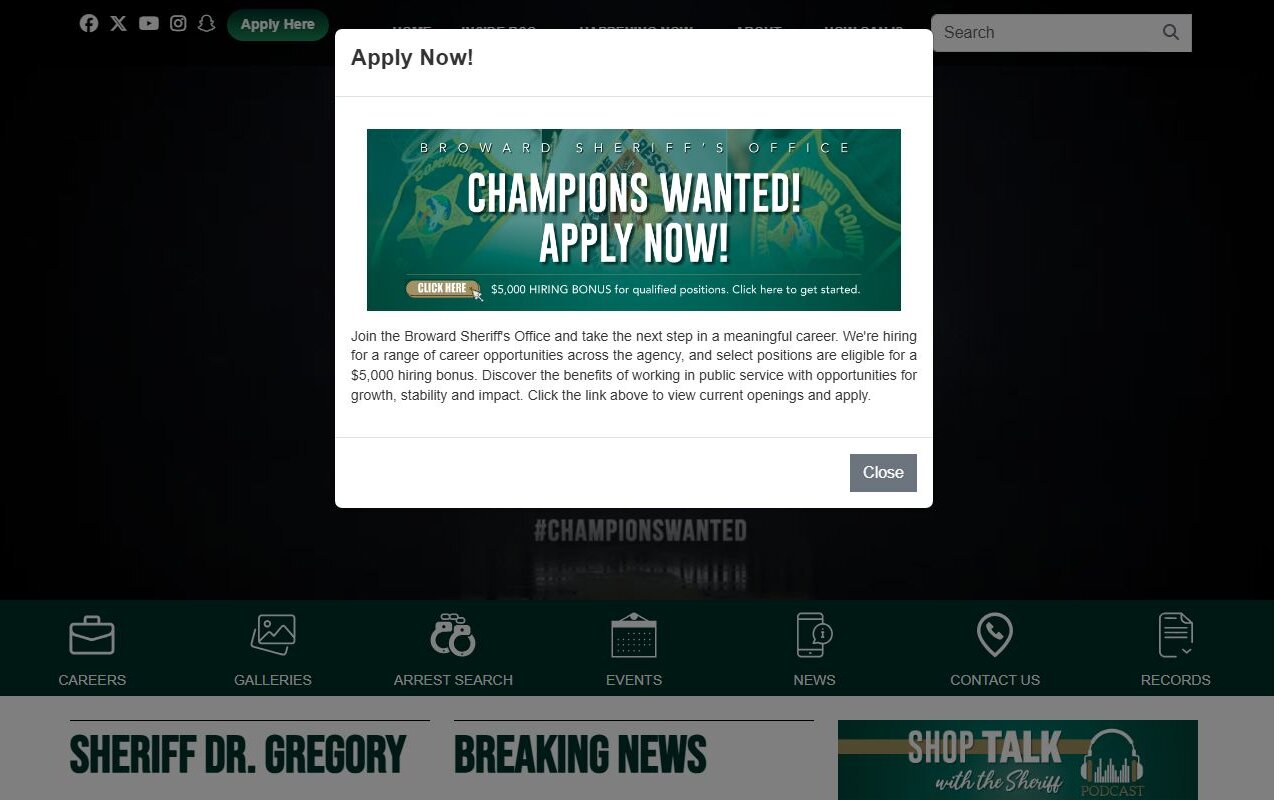
The Sheriff's site is the starting point for Broward County arrest records, jail mail rules, and the visitor portal.
To find a person in custody, use the BSO Arrest Search. The form is short. Last name is the main field. First name narrows the result list.
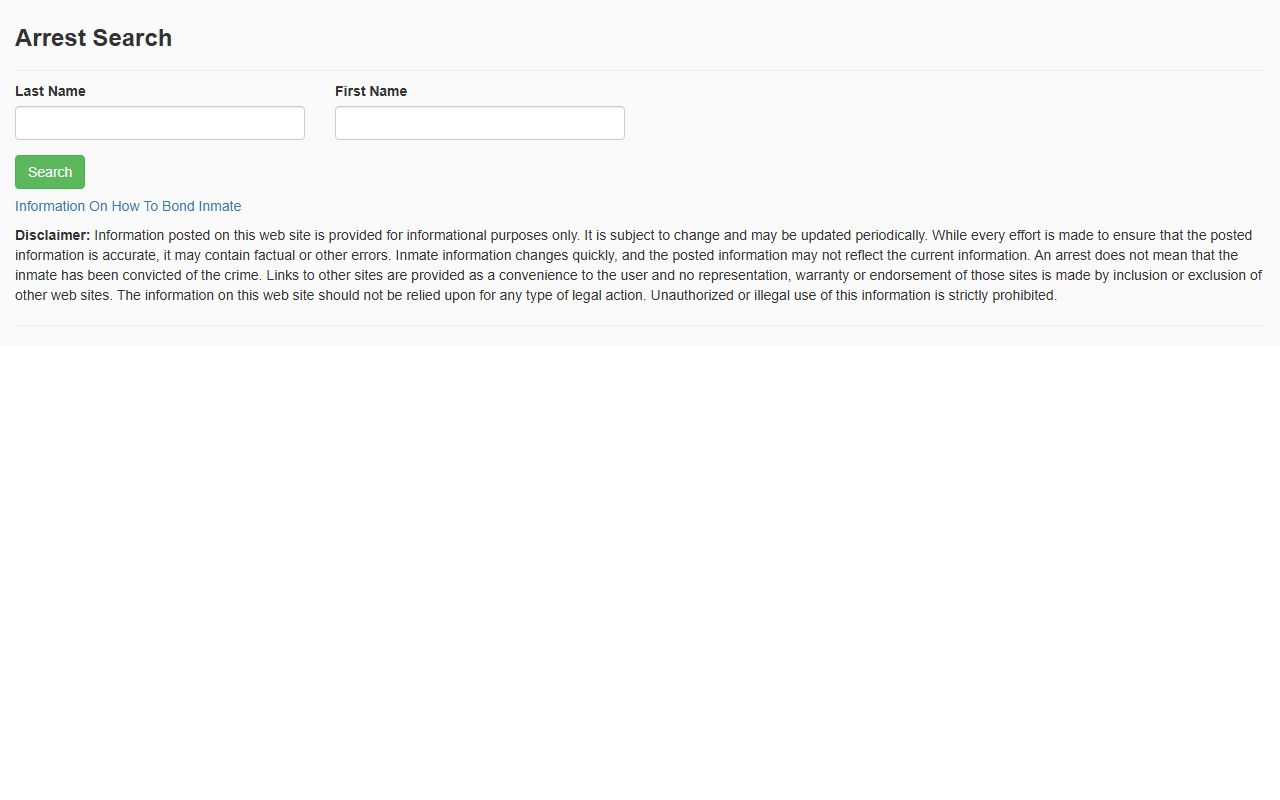
The BSO Arrest Search updates every 15 minutes and shows arrest number, name, sex, and location. For full case detail, jump to the Clerk's case search. See Broward County inmate records for the roster walkthrough and warrant records for active warrants.
Marriage, Divorce, and Probate Records
The Clerk's Marriage Division at the Midrise Building issues marriage licenses for residents and nonresidents. The standard license fee is $86.00. With an approved premarital course certificate, the fee drops to $61.00 and the license is effective the same day. Divorce filings live in the Family division at the Central Courthouse West Building. Probate cases run in the Probate Division of the Circuit Court. See Broward marriage and divorce records and Broward probate records for the full walkthroughs.
Probate uses its own vocabulary. The short glossary below covers the most common terms.
- Testator
- The person who wrote the will.
- Executor or Personal Representative
- The person the court appoints to administer the estate.
- Decedent
- The person who died and whose estate is open.
- Intestate
- A death without a valid will, where the state's intestacy rules control.
- Guardian
- The person the court appoints to manage decisions for a ward.
- Ward
- An incapacitated adult or a minor under guardianship.
Broward Court Records Fees
The Clerk publishes a fixed fee schedule for copies, certification, and search work. The fees and costs page lists the full list. The table below holds the items most users need.
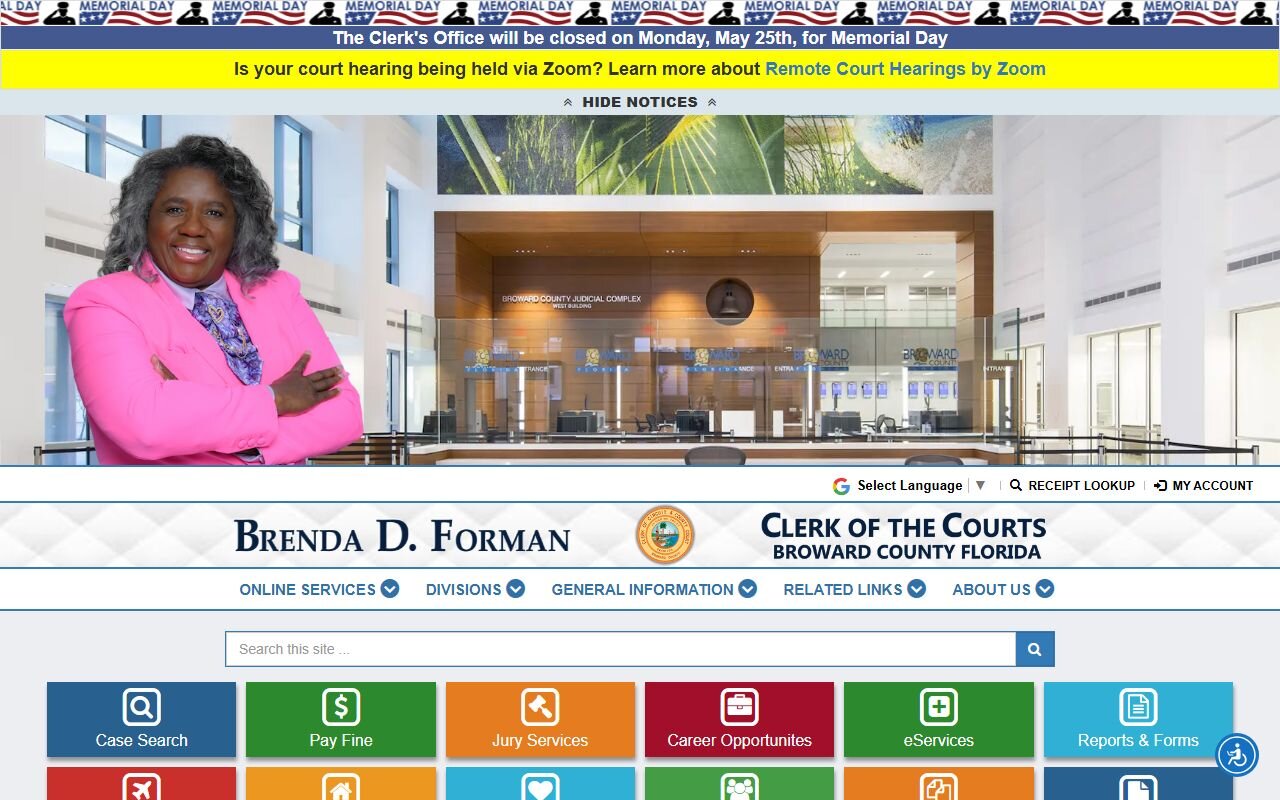
That official Clerk site is the live source for fee changes, payment options, and forms used for Broward County Court records.
| Item | Amount |
|---|---|
| Electronic certified court document | $8.00 per document |
| Plain copy of a court document | $1.00 per page |
| Certification | $2.00 per document |
| Records search | $2.00 per year searched |
| Standard marriage license | $86.00 |
| Marriage license with premarital course | $61.00 |
| Marriage record first copy | $5.00 |
| Each additional marriage record copy | $3.00 |
| Dissolution or annulment of marriage filing | $409.00 |
Note: documents over 100 pages cannot be bought as an online electronic certified document and must come from in-person service or a records request.
How to Interpret Broward County Court Records
Case dockets carry short codes that confuse new users. A capias is an arrest order issued by the court, often after a failure to appear. A bench warrant is issued by the judge from the bench. ROR means release on recognizance, a release without a money bond based on a promise to come back to court. Withhold adjudication is a Florida disposition where the court does not enter a formal finding of guilt even after a plea or a verdict, subject to conditions the judge sets.
An arrest does not mean a conviction. The BSO arrest record and the Clerk case docket are two separate files for the same event. The arrest record sits with the Sheriff. The case record sits with the Clerk. The disposition is the only field that shows the outcome of the criminal charge. A person who reads only the arrest entry without checking the Clerk's disposition can draw the wrong conclusion about a Broward County Court case.
Accuracy and Record Limitations
Online court data is not the official court record. The Clerk's own notice on the case search states that the information on the site does not constitute the official court records of the Clerk. Records sometimes lag the courtroom. A docket can show "pending" hours after a hearing. Bond changes can take time to post. A capias can stay visible after a recall paper has been signed in court.
Note: Confirm any Broward County Court record detail with the originating Clerk division or the Sheriff before relying on the online entry for a court appearance or a legal step.
History of Broward County Courts
Broward County was created in 1915. Fort Lauderdale is the county seat. The modern court system runs under Florida's post-1972 simplified trial structure, which trimmed Florida's older patchwork of local courts into circuit courts and county courts. Broward sits in the Seventeenth Judicial Circuit, one of twenty in the state. The Fourth District Court of Appeal handles Broward appeals.
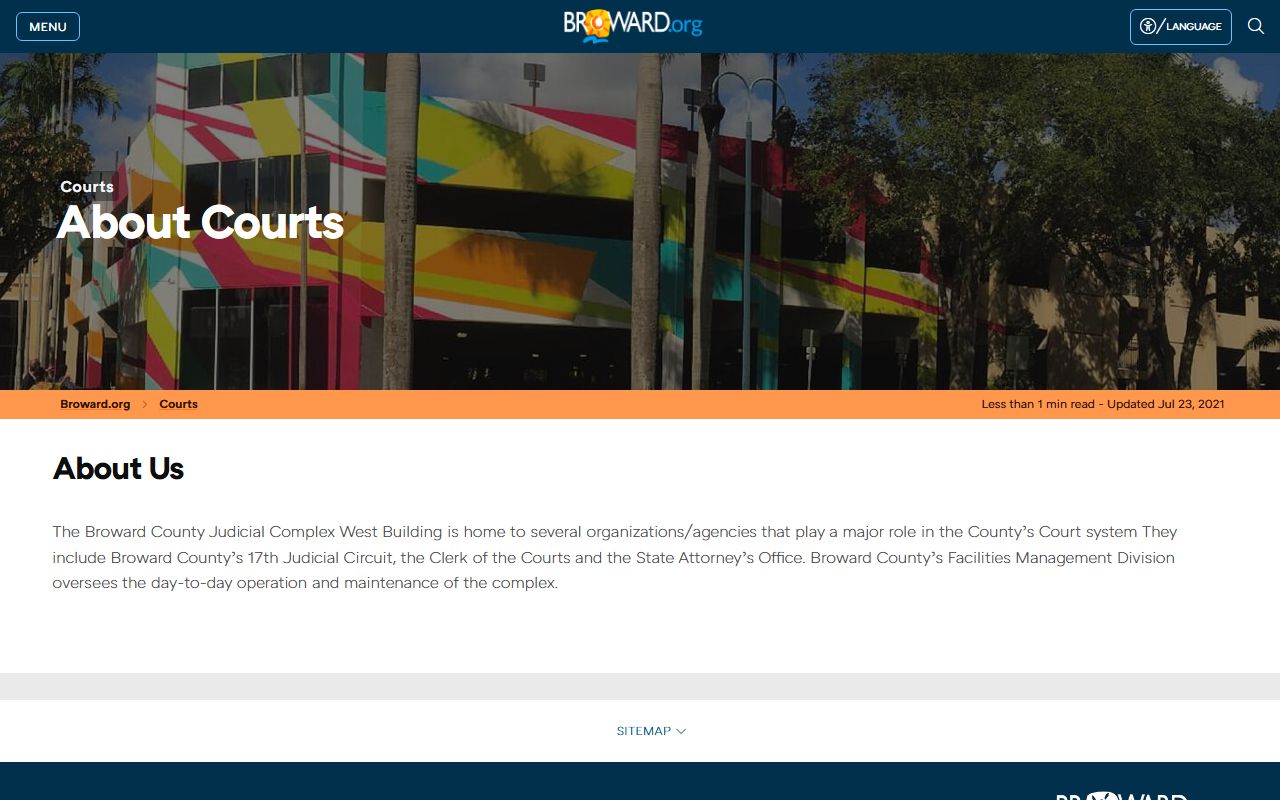
The Broward County court services page is the county government view of the same court system and explains how facility services support Clerk, Circuit Court, and State Attorney operations.
The downtown Fort Lauderdale jail history is short but specific. Main Jail was built in 1985 at $41.6 million and expanded in 1988 and 1992 to capacity 1,538. Conte opened in May 1999 and is named for detention deputy Joseph V. Conte, killed in the line of duty in July 1979. Paul Rein opened in February 2004 with a direct-supervision design modeled after Conte. North Broward Bureau has run at its current site since 1979 and is built around the special-needs mission.
Frequently Asked Questions
Five common questions come up across Broward court searches. Full answers live on the Broward FAQ page.
Who is the Broward Clerk of Court?
The elected Clerk is Brenda D. Forman, Clerk of the Circuit and County Courts. Her official biography states she was first elected in 2016, reelected in 2020, and reelected to a third term in 2024. She is the first African American and first elected female Clerk in Broward.
Why can a Broward court case show but no document image opens?
Florida access standards split the docket layer from the document layer. The Clerk says Domestic Violence, Family, Guardianship, Mental Health, and Probate electronic records require an Attorney of Record or Registered User account before any image will open.
How fast is the BSO Arrest Search?
The BSO Arrest Search page states returns are updated every 15 minutes and shows a current-as-of timestamp. A new arrest may not appear for a short time after Central Intake processing. Always confirm a custody status by phone if a court date or release is at stake.
How much is a certified electronic court document?
The Clerk lists electronic certified court documents at $8.00 per document. Only viewable electronic documents qualify. Documents over 100 pages are not sold online and need an in-person or records-by-request route.
More on the Broward County Court Records FAQ page.