
How Broward County Criminal Records Work
Two agencies build the criminal record of a single event in Broward. The Broward Sheriff's Office books the arrest. The Clerk of the Circuit and County Courts opens the court file. The Sheriff's record holds the arrest number, the booking photo, the charge sheet, and the custody location. The Clerk's record holds the formal information or indictment, the docket, the orders, and the disposition. The State Attorney for the 17th Judicial Circuit files the formal charges in court.
Felony cases live in Circuit Criminal at the Central Courthouse North Building, 201 SE 6th Street. Misdemeanor and county criminal cases live in the County Court at the same complex. Both flow through the Clerk's case system, so the public search for a Broward criminal court file is the same regardless of whether the charge is a felony or a misdemeanor.
Broward County Arrest Records Search
The Sheriff runs the BSO Arrest Search for current custody records. The portal updates every 15 minutes and shows arrest number, name, sex, and current location. Clicking the arrest number opens the booking detail. The Sheriff warns that an arrest does not mean a conviction.
| Field | Type | Required | Notes |
|---|---|---|---|
| Last Name | Text | Yes | Use the legal last name from booking. |
| First Name | Text | No | Narrows the result list. |
| Search | Button | n/a | Returns matching arrest records. |
| Captcha | Challenge | Sometimes | May appear before the result list. |
Result columns show ARREST NO., NAME, SEX, and LOCATION. The arrest number is a clickable identifier that opens the booking detail with photo and charges.
Broward Criminal Court Records Search
The Clerk's case search holds the court docket for every Broward criminal case. Search by party name or case number. The portal lets the user filter by court type, so a search can target felonies only or misdemeanors only. Sealed and expunged cases drop out of the public results entirely.
Sample criminal case detail fields a user can expect:
- Case number and court type
- Defendant name and any co-defendants
- State Attorney filing date and statute charged
- Arrest date and arresting agency
- Bond amount and bond posted
- Progress docket with hearings, motions, pleas, and orders
- Disposition and sentence
- Probation and supervision events
- Capias, warrant, and recall entries
Broward Criminal Charges vs Convictions
A charge is not a conviction. A Broward arrest record may show a charge that was later dropped, reduced, or dismissed by the State Attorney or by the court. The disposition field is the only field that shows the outcome of the criminal charge. A reader who reviews only the arrest entry without the disposition can draw the wrong conclusion about the case.
| Field | Charge | Conviction |
|---|---|---|
| What it is | A formal accusation of a crime. | A court finding or plea of guilt. |
| Where it sits | Arrest report, information, or indictment. | Judgment of conviction or adjudication order. |
| Who decides | Police, State Attorney, or grand jury. | Judge or jury. |
| Effect on record | Public but not proof of guilt. | Public proof of guilt unless sealed or expunged. |
| Common Broward entry | Felony Information filed; Charges added. | Adjudicated guilty; Sentenced. |
| Withhold adjudication | n/a | Court withholds formal adjudication despite plea or finding. |
Public Access to Broward Criminal Records
Florida public access rests on Article I, section 24 of the Florida Constitution, Chapter 119 of the Florida Statutes, and Florida Rule 2.420. Criminal court files are public unless sealed, expunged, or otherwise restricted by court order or by law. Active criminal investigative information held by the Sheriff is exempt under section 119.071 until the investigation closes.
Section 119.07 requires the custodian to allow inspection and copying. The Clerk implements the statewide access rules and limits Domestic Violence and Family electronic records to Attorney of Record or Registered User access. Juvenile delinquency records are restricted under Florida law and rules.
Sealed vs Expunged Criminal Records in Broward
Florida treats sealing and expunction as two related but distinct tools. Both remove public access to a Broward criminal record. The two differ on what survives, who keeps access, and how the file is destroyed. The table below maps the two.
| Feature | Sealed | Expunged |
|---|---|---|
| Statute | § 943.059 | § 943.0585 |
| Public access | Removed from public view. | Removed from public view and ordered destroyed at custodial agencies. |
| Government access | Limited access for some agencies and licensing. | Tighter access; some agencies still receive notice of existence under court order. |
| Eligibility | No prior sealing or expunction; offense not on the disqualifying list. | Charges not resulting in adjudication; usually after dismissal, no-file, or nolle prosequi. |
| Process | Apply to FDLE for Certificate of Eligibility; petition the Broward court. | Apply to FDLE; petition the Broward court. |
| Effect on Broward search | Case index no longer public. | Case index no longer public and physical records destroyed where ordered. |
The FDLE seal and expunge FAQ covers the full process. The Broward State Attorney's site has posted public service announcements on the seal and expunge process and runs a Seal and Expunge support resource for eligible cases.
State Attorney and Public Defender Roles
Florida uses "State Attorney" rather than district attorney. Broward is served by the Office of the State Attorney for the 17th Judicial Circuit, led by State Attorney Harold F. Pryor. The office is at 201 SE 6th Street, Suite 07150, with the main phone 954-831-6955. The State Attorney files formal charges, runs the diversion programs, and handles the conviction review unit.
The Law Office of the Public Defender, Seventeenth Judicial Circuit represents indigent defendants charged with criminal offenses in Broward. The office is at 201 SE 6th Street, Suite 3872, Third Floor, North Wing. A defendant applies through the Clerk using the Application for Criminal Indigent Status. In-custody applicants receive the application before first appearance.
FDLE Criminal History and the Sex Offender Registry
The Broward Sheriff's local records check is not a full statewide criminal history. The Florida Department of Law Enforcement runs the statewide system. A Florida criminal history request through FDLE returns arrest and disposition data submitted by Florida agencies. A full national check needs a fingerprint-based search.
FDLE also runs the Florida Sexual Offender and Predator Registry. The registry is a public-record resource. FDLE states that positive identification needs a fingerprint comparison and that registry placement is not intended to indicate risk level.
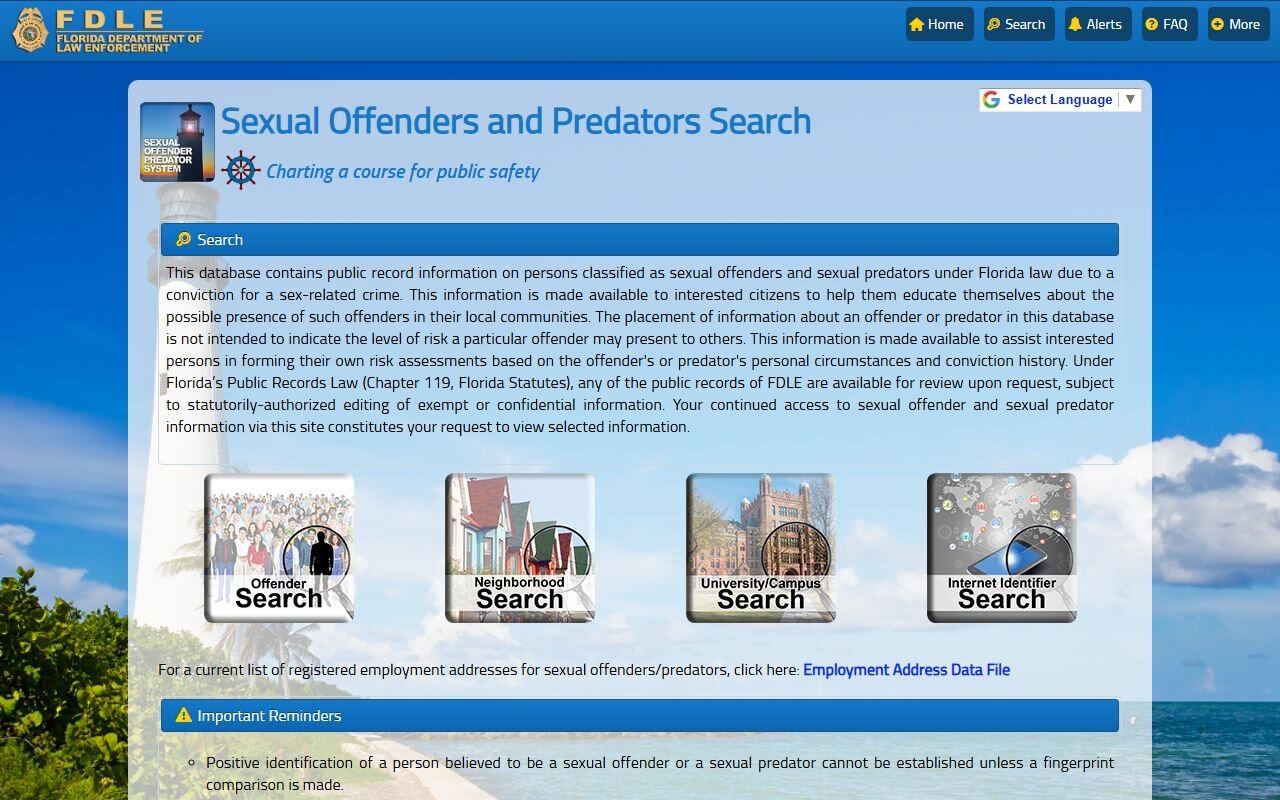
The FDLE registry page above is the official source for offender and predator searches that feed into Broward criminal background work.
| FDLE Registry Field | Notes |
|---|---|
| Offender Search | Search by name and identity. |
| Neighborhood Search | Address or radius search. |
| University/Campus Search | Campus-specific search. |
| Internet Identifier Search | Search by registered internet identifier. |
Warrants, Capias, and Bond on Broward Criminal Records
The Broward Sheriff does not publish a separate active warrant search. Warrants and capias entries live on the Clerk's case docket. A capias is the Florida court order that triggers an arrest. A bench warrant is similar but issued by the judge from the bench. A warrant recalled or quashed entry means the court withdrew the order. A bond estreated entry signals bond forfeiture after a failure to appear. For the full warrant walkthrough, see Broward warrant records.
Bond appears on the docket and on the BSO arrest detail. The first appearance hearing usually runs the day after arrest at 8 a.m. before a magistrate judge. The judge advises charges and may set or modify bond. If a Broward defendant is in custody, the next step is the inmate records page for facility detail.
DUI, DWI, and Criminal Traffic Cases
DUI and DWI cases route through the County Criminal docket in Broward. The case is a criminal matter, not a civil traffic citation. A DUI case shows on the Clerk's case search like a misdemeanor or felony, depending on charge level. Convictions feed into the Florida driver record kept by Florida Highway Safety and Motor Vehicles. CDL holders should get legal advice before electing options because federal and state CDL reporting rules differ from those for ordinary Class E drivers. For citation-only matters, see Broward traffic court records.